
Saddle stitch vs perfect binding vs spiral binding
The binding you pick decides your page count rules, whether the book lies flat, and how the pages must be laid out for printing.
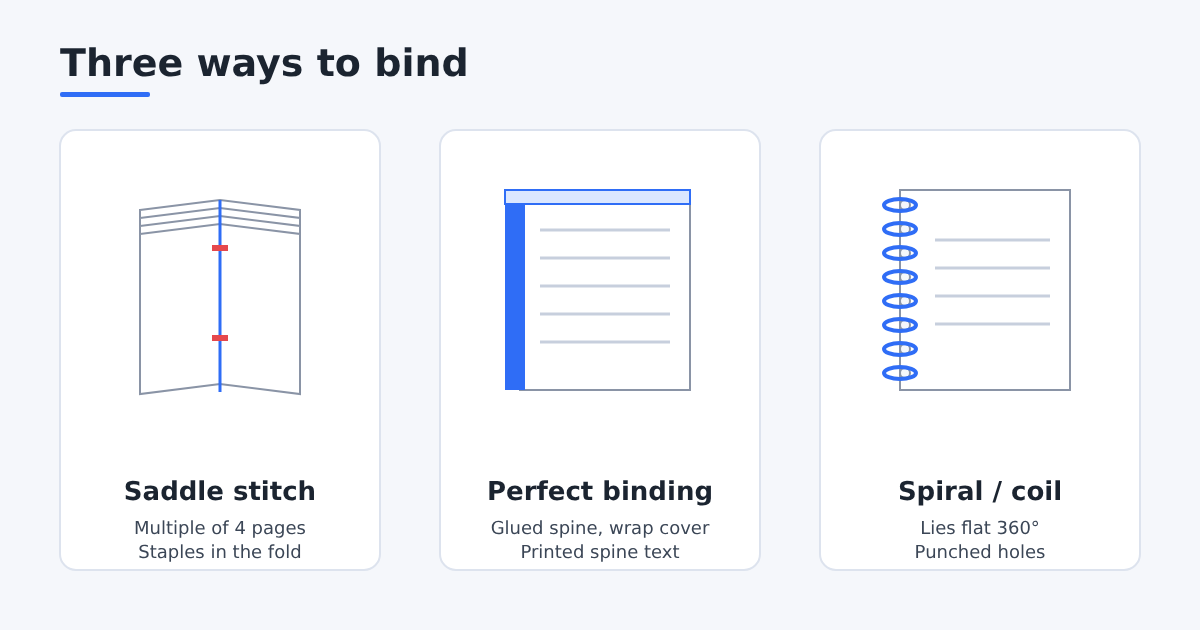
At a glance
| Saddle stitch | Perfect binding | Spiral / coil | |
|---|---|---|---|
| How it is held | Folded sheets, wire staples through the fold | Pages glued at the spine under a wrap cover | Holes punched, a plastic or wire coil threaded through |
| Page count | Multiple of 4, usually thin (roughly up to 60 to 80 pages, depends on paper) | Thicker books, often from about 40 pages up | Almost any, even page count |
| Spine | None, so no spine text | Flat spine you can print on | Coil, no printed spine |
| Lies flat | Mostly | No | Yes, even folds back 360° |
| Cost | Lowest | Medium | Low to medium |
| Typical use | Magazines, brochures, programs | Catalogs, novels, manuals | Notebooks, calendars, workbooks |
Exact limits depend on your printer, the paper weight and the equipment, so confirm with them before finalising.
Saddle stitch
Saddle stitching binds a booklet by nesting folded sheets inside each other and stapling them through the fold. Because every sheet gives 4 pages, the total must be a multiple of 4; a 30-page job becomes 32. Pages must be imposed in a special order (see the booklet page order calculator). Thick stacks push the inner pages outward, so printers trim the front edge; the effect is called creep.
Perfect binding
Perfect binding glues the pages to a wrap-around cover at the spine: the pages are stacked, the spine edge is roughened and glued, then the cover is attached. The cover needs a spine whose width depends on page count and paper thickness; estimate it with the book spine width calculator. Pages must be laid out in reading order for the printer's folding signatures, and the binding eats some of the inner margin, so leave extra gutter space.
Spiral and coil
Spiral (coil) binding holds loose sheets with a plastic or metal coil threaded through holes punched along one edge. It lies flat and the pages turn easily, so it suits workbooks and calendars. Keep important content at least about 10 mm away from the punched edge so holes never hit text.
Worked examples
Saddle stitch, 24 pages, A5 finished. Each A4 sheet folds into 4 A5 pages, so 24 ÷ 4 = 6 sheets, printed on both sides and nested inside each other. If the text runs to 26 pages, the next multiple of 4 is 28: plan two extra pages (a notes page, an ad, the inside back cover) instead of leaving blanks at random.
Perfect binding, 200 pages, 80 gsm uncoated paper. 200 pages are 100 leaves. Plain 80 gsm office-type paper is about 0.1 mm thick, so the block is roughly 100 × 0.1 = 10 mm, and the cover spine is set to that plus a little for the cover board. Coated paper of the same weight is thinner, bulky book paper is thicker, which is why the spine width calculator asks for the paper type. Offset printers also fold pages in signatures of 8, 16 or 32 pages, so a count that fills whole signatures is cheaper.
Spiral, 50 pages printed one side. A coil holds single leaves, so 50 leaves need nothing special in the page order. What matters is the coil diameter: ask your finisher which size fits 50 leaves plus covers, because a coil that is too tight stops the pages turning.
Margins for each binding
| Binding | Inner margin (gutter) | Outer edges | Why |
|---|---|---|---|
| Saddle stitch | 10 to 12 mm | 5 mm safe area + creep | Staples sit in the fold, inner pages shift outward |
| Perfect binding | 15 to 20 mm | 5 mm safe area | Glue and the curve of the spine hide part of the inner edge |
| Spiral / coil | 12 to 15 mm on the punched side | 5 mm safe area | Holes are punched about 4 to 6 mm from the edge |
Treat these as safe starting points and replace them with your printer's numbers when you have them.
Other bindings you may be offered
- Wire-O (twin loop): like spiral, but with a double metal loop. It looks more formal and is common for reports and desk calendars.
- PUR binding: perfect binding with a stronger polyurethane glue. Pages hold better and the book opens a little flatter, at a higher price.
- Sewn and case binding: signatures are sewn together and fixed into a hard cover. It is the most durable option and the most expensive, used for hardback books and photo books.
Common mistakes
- Sending a saddle-stitch file with a page count that is not a multiple of 4.
- Putting a full-width image across the spread of a perfect-bound book, where the middle disappears into the glue.
- Forgetting that the cover of a perfect-bound book is one wide piece: back, spine and front together.
- Putting page numbers or text too close to the punched edge of a spiral book.
Which should I choose?
- Under about 48 pages and a tight budget: saddle stitch.
- A catalog or book that needs a printed spine and a polished look: perfect binding.
- Something people write on or use at a desk: spiral.
Trimto's booklet and catalog imposition supports all three, and shows the page order and the cover layout for each. To start with the basics, read What is imposition?
Sources
- Wikipedia, Bookbinding: overview of binding methods, signatures and case binding.
- Wikipedia, Saddle stitch, Perfect binding and Spiral binding.