
How many business cards fit on A4, A3, SRA3?
The count depends on the card size, the sheet size, and whether you add bleed. The numbers below assume a straight grid and the full sheet usable. Without bleed, cards touch; with bleed, each card carries its own 3 mm bleed (details under the table). In real life your printer needs a gripper edge or margin of several millimeters, which can cost a row.
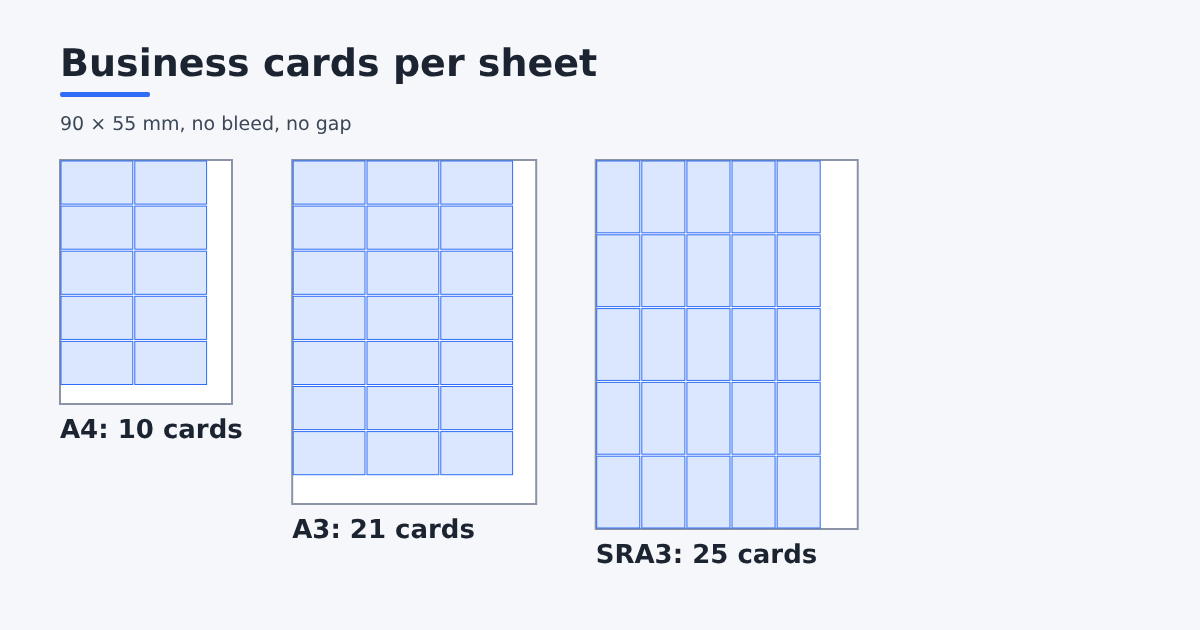
90 × 55 mm cards (Nordics, India, Australia, Vietnam)
| Sheet | Size (mm) | No bleed | With 3 mm bleed |
|---|---|---|---|
| A4 | 210 × 297 | 10 | 9 |
| A3 | 297 × 420 | 21 | 18 |
| SRA3 | 320 × 450 | 25 | 21 |
| Letter | 215.9 × 279.4 | 10 | 8 |
| Tabloid | 279.4 × 431.8 | 21 | 16 |
3.5 × 2 in cards (88.9 × 50.8 mm, US standard)
| Sheet | Size (mm) | No bleed | With 3 mm bleed |
|---|---|---|---|
| A4 | 210 × 297 | 12 | 10 |
| A3 | 297 × 420 | 24 | 21 |
| SRA3 | 320 × 450 | 30 | 21 |
| Letter | 215.9 × 279.4 | 12 | 8 |
| Tabloid | 279.4 × 431.8 | 24 | 16 |
"With bleed" means each card grows by 3 mm on all four sides (6 mm in each direction) and cards touch. Both card orientations were tried and the better one kept.
Reading the table
- Bleed costs between one and four cards per sheet here; on the bigger sheets it can cost more, because the grid loses a whole row or column.
- If your press needs a 5 mm margin all around, the A4 numbers drop (for example 90 × 55 mm with bleed gives 8 instead of 9).
- Orientation matters. Trying both a portrait and a landscape grid is free and sometimes adds a card.
Other card sizes around the world
There is no single standard size. These are the common ones, with the counts on A4 and SRA3 using the same rules as above:
| Card size | Where it is common | A4, no bleed | A4, 3 mm bleed | SRA3, no bleed | SRA3, 3 mm bleed |
|---|---|---|---|---|---|
| 85 × 55 mm | Most of Western Europe, UK | 10 | 9 | 25 | 21 |
| 85.6 × 53.98 mm | Credit card size (ISO/IEC 7810 ID-1) | 10 | 9 | 25 | 21 |
| 90 × 54 mm | China, Hong Kong, Singapore, Malaysia | 10 | 9 | 25 | 21 |
| 91 × 55 mm | Japan | 10 | 9 | 24 | 21 |
The sizes are so close that the counts barely move. What changes the count is bleed, the gap between cards and the printer's margin, not the last millimetre of card width.
Single cut or double cut
The "with bleed" columns assume a double cut: every card keeps its own 3 mm bleed, so there are two cuts between neighbours and a 6 mm strip of waste. With a single cut, cards touch at the trim line and one cut separates them. That gives the "no bleed" count again, plus bleed only around the outside of the grid.
A single cut works when the edges of neighbouring cards can touch without problems, for example white or identical backgrounds. If a card has a dark background or a picture running to the edge, any drift of the blade shows a sliver of the neighbour's design, so use a double cut. Trimto's straight-cut layout offers both, see step and repeat imposition.
How many sheets for my order?
Divide the quantity by the cards per sheet and round up.
- 500 cards of 90 × 55 mm with bleed on SRA3: 500 ÷ 21 = 23.8, so 24 sheets (504 cards).
- 250 cards on A4 with bleed: 250 ÷ 9 = 27.8, so 28 sheets (252 cards).
- Double-sided cards need the same number of sheets, printed on both sides.
Always round up, never down, and add a few spare sheets for colour setup and test cuts.
Paper for business cards
Business cards are printed on card stock. Around 350 gsm (about 12 pt) is the usual weight, 300 gsm feels lighter and 400 gsm or more feels premium. Check that your printer can feed the weight you choose: many office and desktop printers stop at about 250 to 300 gsm, and heavy card often needs the bypass tray.
Work out your own numbers
Your card, paper and margins may differ. The items per sheet calculator takes any size, margin and gap, tries both orientations, and shows the sheets needed for your quantity. When you are ready to lay out the sheet, step and repeat imposition places the cards with crop marks and exports a print PDF.
Sources
- Wikipedia, Business card: card sizes by country, typical weight and bleed.
- Wikipedia, ISO 216 and Paper size: A-series, SRA and North American sheet sizes.